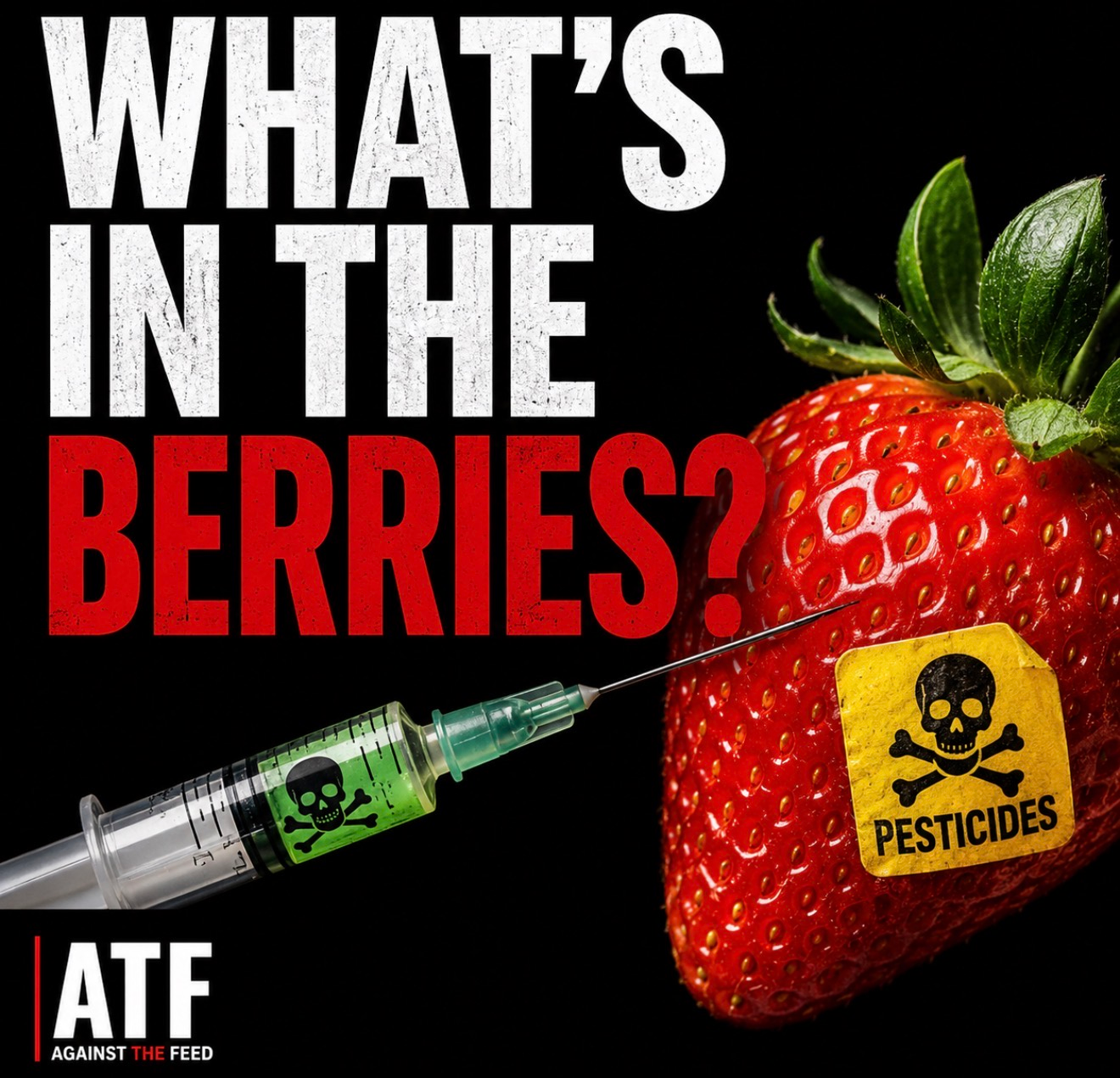
California grows an enormous amount of America’s strawberries. It also uses an enormous amount of pesticides to do it.
That reality is starting to make more people uncomfortable, especially after reports showing childhood cancer rates in Santa Cruz County are reportedly 38% higher than the California average. The same region sits next to Watsonville and the Pajaro Valley, where large-scale berry farming dominates the landscape and millions of pounds of agricultural chemicals are used every year.
To be very clear: there is currently no proof that eating Driscoll’s strawberries causes cancer.
But there is also nothing irrational about people questioning whether constant exposure to agricultural chemicals could be affecting nearby communities over time.
That concern becomes harder to dismiss when you look at what’s actually being sprayed.
Reports show more than 2 million pounds of pesticides are applied annually in the Pajaro Valley. Some of the chemicals used include fumigants like 1,3-Dichloropropene and Chloropicrin, both associated with serious health concerns and tightly regulated due to toxicity risks.
Research has also linked close residential proximity to heavy pesticide application areas with increased risks of childhood leukemia and brain cancer. One frequently cited concern involves children living within roughly 2.5 miles of treated agricultural land.
Again, none of this proves a direct cause between one specific brand of fruit and cancer. Science does not work that way, despite what social media comment sections think after watching two TikToks and half a podcast clip.
What it does raise is a larger question that many Americans increasingly have about industrial agriculture in general:
How much long-term chemical exposure are people actually living around in major farming regions, and are current safety standards truly protecting families?
That question is getting harder to brush aside as more independent consumer testing groups investigate pesticide residues on produce. A recent Mamavation investigation reportedly found residues from multiple pesticides in conventional strawberries, including several compounds classified as PFAS-related “forever chemicals.” Organic samples reportedly showed no detectable residues during the same testing.
Driscoll’s says it follows all EPA regulations and scientific best practices, and there is no evidence showing its products are unsafe when consumed as directed.
Still, public trust around chemical exposure has changed dramatically over the last decade. Americans have watched repeated situations where substances once considered safe later became major public health concerns. That history is part of why conversations like this no longer disappear the moment someone says “within regulatory limits.”
For many families, this is not political. It is practical.
Parents living near heavily sprayed farmland want to know what is in the air around their homes, what ends up in local groundwater, and what repeated low-level exposure may look like over the course of years.
That does not make them conspiracy theorists.
It makes them people paying attention.
What consumers are doing
- Buying organic strawberries when possible
- Washing produce thoroughly before eating
- Buying from smaller local farms with transparent growing practices
- Following pesticide reporting and food safety investigations more closely
- Asking more questions about large-scale agricultural chemical use near residential communities
And honestly, that last one seems reasonable. Because when millions of pounds of chemicals are being sprayed near homes, schools, and neighborhoods every year, people are probably going to want more than a corporate press release telling them everything is fine.